Customer service
Free delivery from an EU warehouse · on average 4–8 working days to your door
Log in
0 € 0

Frequently asked questions

An electric bike battery typically takes 3–6 hours to charge, although the exact charging time depends on several factors. Charging the battery correctly can help speed up the process and extend its lifespan.

Factors that affect electric bike battery charging time

Battery capacity (Wh)
A larger battery requires more time to charge. For example, a 500–625 Wh battery typically takes longer to charge than a 400 Wh battery.

Charger output
A higher-powered fast charger can significantly reduce charging time. However, always use the charger recommended by the manufacturer to ensure battery safety.

Battery charge level before charging
A fully depleted battery naturally takes longer to charge than one that is only partially discharged.

Temperature and weather conditions
Cold temperatures slow down charging, while charging at room temperature or in a warm environment is more efficient.

How to optimise electric bike battery charging

  • Charge the battery regularly instead of letting it discharge completely.
  • Store and charge the battery at room temperature whenever possible.
  • Always use a compatible, high-quality charger.
  • Avoid storing the battery fully discharged or fully charged for extended periods.

A well-maintained battery charges more efficiently, lasts longer, and keeps your electric bike ready to ride whenever you need it.

An electric bike typically has a range of 40–120 kilometres on a single charge. The actual range depends on battery capacity, riding conditions, and how the bike is used. A high-quality battery and proper use can significantly increase your bike’s range.

Factors that affect electric bike battery range

Battery capacity (Wh)
Electric bikes are available with batteries of various capacities, such as 400 Wh, 500 Wh, or 625 Wh. The larger the capacity, the longer the riding range on a single charge.

Riding style and terrain
Hilly terrain, headwinds, and high assistance levels drain the battery more quickly. Riding on flat roads with moderate assistance provides a significantly longer range.

Rider weight and cargo
A heavier rider or additional cargo increases the motor’s workload, reducing battery life and riding range.

Weather and temperature
Cold weather reduces battery performance and riding range, while warmer temperatures improve battery efficiency.

How to extend your electric bike battery range

  • Use a lower assistance level whenever possible.
  • Avoid sudden acceleration and maintain a steady riding style.
  • Charge the battery regularly without letting it discharge completely.
  • Store the battery in a dry place, preferably at room temperature.
  • Keep your tyres properly inflated to minimise rolling resistance.

A well-maintained battery retains its capacity for longer, provides greater range, and ensures reliable electric bike performance in all conditions.

In Europe, including Finland, electric pedal assistance is limited to a maximum speed of 25 km/h. This legal limit allows an electric bike to be classified as a regular bicycle, meaning no registration or driving licence is required.

It is important to note that this limit only applies to motor assistance. You can exceed 25 km/h by pedalling under your own power, for example when riding downhill.

Key legal requirements in Finland

Maximum motor output: 250 W
To qualify as an electrically assisted bicycle, the motor’s continuous rated power must not exceed 250 watts. Assistance is only provided while pedalling and must stop at 25 km/h.

Faster electric bikes (speed pedelecs)
If motor assistance continues above 25 km/h or the motor exceeds 250 W, the vehicle is no longer classified as a bicycle. It is generally classified as an L1e-B moped, which typically requires:

  • Vehicle registration
  • Motor vehicle insurance
  • A valid driving licence (at least AM category)
  • An approved moped helmet
  • Possible restrictions on using cycle paths

Other factors that affect speed

Assistance level
Most electric bikes allow you to adjust the assistance level. Higher assistance makes riding easier and helps you reach 25 km/h more quickly.

Terrain and weather conditions
Hills, headwinds, road surfaces, and overall riding conditions all influence how easily you can reach the maximum assisted speed.

Rider effort and bike weight
Since an electric bike is still a bicycle, the rider’s own pedalling power also affects the final speed.

Can you ride faster than 25 km/h on an electric bike?

Yes, but only without motor assistance. When riding downhill or pedalling hard, your speed can exceed 25 km/h because the legal limit only applies to the motor’s assistance.

A properly classified electric bike provides a safe, convenient, and legal way to travel without registration or insurance while making cycling easier, especially in headwinds and hilly terrain.

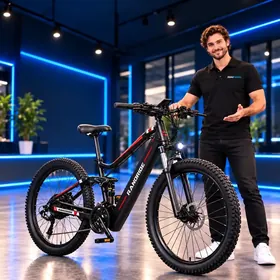
ebike

Withdraw from contract

How to place an order